

If you’ve ever tried to be “the understanding one” in every
conversation, you already know the hidden cost: empathy can start feeling like
a job you didn’t apply for. You listen, you hold space, you soften your tone,
you try to interpret people generously—and then you go home depleted,
resentful, or numb. That’s not a character flaw. That’s a system problem:
you’re trying to run a beautiful relational skill through a nervous system that
has limits.
Empathy isn’t meant to be endless emotional labor. It’s
meant to be a choice, offered in a way that keeps you connected to both
people in the interaction: the other person and you. When empathy
becomes self-erasure, it stops being empathy and turns into
over-responsibility. When empathy becomes compulsive, it turns into a
pattern—something your body does to prevent conflict, avoid guilt, or keep
attachment safe.
This post will help you build empathy as a sustainable
skill, not a self-sacrificing identity. We’ll define what empathy actually is,
why it’s so easy to burn out, and how to practice empathy without burnout
through boundaries, regulation, and simple relational tools you can use
immediately.
Empathy is often described as “feeling what someone else feels,” but that definition sets people up to crash. If empathy means absorbing everyone’s emotions, then of course you’ll burn out—because you’re treating empathy like emotional sponge work.
A more sustainable definition is this:
Empathy is the ability to understand and respond to another person’s internal experience without abandoning your own.
Notice the two parts: understand and respond—and without abandoning your own. That second part is the entire difference between healthy empathy and burnout empathy.
It helps to break empathy into three distinct skills:
Burnout usually happens when emotional empathy runs the whole show, without cognitive clarity or compassionate limits. In other words: you feel too much, too fast, and you don’t know where you end.
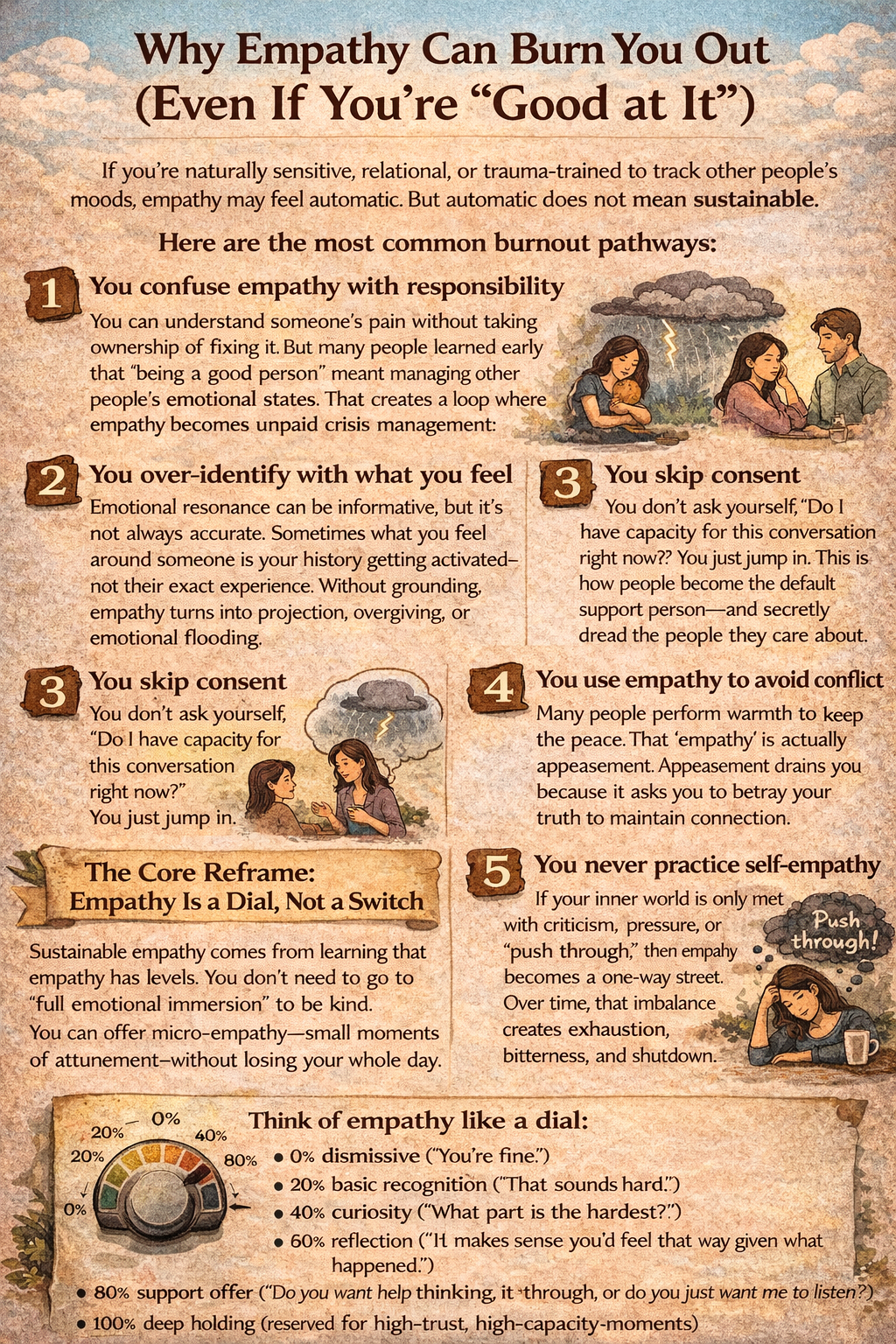
Empathy Burn Out (Even If You’re “Good at It”)
If you’re naturally sensitive, relational, or trauma-trained to track other people’s moods, empathy may feel automatic. But automatic does not mean sustainable.
Here are the most common burnout pathways:
1) You confuse empathy with responsibility
You can understand someone’s pain without taking ownership of fixing it. But many people learned early that “being a good person” meant managing other people’s emotional states. That creates a loop where empathy becomes unpaid crisis management.
2) You over-identify with what you feel
Emotional resonance can be informative, but it’s not always accurate. Sometimes what you feel around someone is your history getting activated—not their exact experience. Without grounding, empathy turns into projection, overgiving, or emotional flooding.
3) You skip consent
You don’t ask yourself, “Do I have capacity for this conversation right now?” You just jump in. This is how people become the default support person—and secretly dread the people they care about.
4) You use empathy to avoid conflict
Many people perform warmth to keep the peace. That “empathy” is actually appeasement. Appeasement drains you because it asks you to betray your truth to maintain connection.
5) You never practice self-empathy
If your inner world is only met with criticism, pressure, or “push through,” then empathy becomes a one-way street. Over time, that imbalance creates exhaustion, bitterness, and shutdown.
Burnout is not proof that you’re not empathetic. Burnout is often proof that you’re empathetic without structure.
The Core Reframe: Empathy Is a Dial, Not a Switch
Sustainable empathy comes from learning that empathy has levels. You don’t need to go to “full emotional immersion” to be kind. You can offer micro-empathy—small moments of attunement—without losing your whole day.
Think of empathy like a dial:
Burnout happens when you live at 80–100% with everyone, every day.
Empathy without burnout means you learn to choose the dial setting that matches:

Step 1: Build “Emotional Boundaries” So Empathy Doesn’t Become Absorption
Emotional boundaries are the internal lines that help you care without taking over. They separate compassion from fusion.
Here are three boundary statements to train internally:
If you tend to absorb, try this quick mental move during intense conversations:
Name what’s theirs vs. what’s yours.
That tiny differentiation creates space. Space is where empathy becomes a choice instead of a reflex.
Step 2: Learn the Difference Between Empathic Listening and Fixing
A major empathy drain is the compulsion to solve. Fixing looks like empathy because it’s active, but it often bypasses the actual need: to be seen and understood.
Empathic listening is not about producing the perfect advice. It’s about communicating, “I’m with you.”
Try this three-part structure:
Example:
This reduces burnout because you stop providing full-service emotional labor by default. You become present without becoming responsible.
Step 3: Practice “Nervous System Regulation” Before You Go Deep
Empathy is not only a mindset skill—it’s a physiology skill. If your body is activated, your empathy gets distorted. You might overreact, people-please, freeze, or emotionally collapse. Sustainable empathy requires nervous system regulation, even in small doses.
Here are quick regulation options you can do mid-conversation:
These aren’t performance tricks. They’re signals to your system: I’m safe enough to stay present.
When your body is regulated, you can offer empathy without losing yourself.
Step 4: Use “Capacity Checks” as a Normal Part of Empathy
One of the most sustainable empathy habits is asking for internal consent before engaging. Most people skip this and then wonder why they’re depleted.
Ask yourself:
If the answer is “not much,” you can still be kind—just more contained.
Try a capacity-based response:
This is empathy without burnout in real time: warm truth plus clear limits.
Step 5: Stop Confusing Empathy With Unlimited Access
Being empathetic does not mean you are always available. It does not mean you owe immediate replies. It does not mean you must “hold space” on demand.
A sustainable empathic person has access policies—even if they’re informal.
Consider setting simple rules like:
These are not walls. They are containers. Containers protect relationships because they prevent resentment.
Step 6: Develop Self-Empathy So Your Giving Has a Source
Self-empathy is the practice of meeting your own emotions with the same respect you offer others. Without it, empathy becomes draining because you’re pouring from a cup you keep criticizing.
Self-empathy sounds like:
If you struggle with self-empathy, start with neutral acknowledgment rather than forced positivity:
That kind of internal honesty reduces burnout because your system doesn’t have to fight your reality while also supporting someone else.
Step 7: Choose Your “Lane” in Each Conversation
Empathy gets exhausting when you try to do everything at once: validate, advise, soothe, mediate, and carry. Instead, pick one lane.
Here are four lanes you can choose from:
You don’t need to be in the same lane every time. But choosing a lane keeps you from unconsciously escalating your effort until you’re empty.
Step 8: Watch for Empathy Fatigue and Compassion Fatigue Early
Two terms matter here:
You don’t need to be a therapist to experience these. They can show up in friendships, family systems, leadership roles, and caregiving.
Early signs include:
These signs are not moral failures. They’re data telling you your empathy system needs recovery and structure.
Step 9: Use Ready-to-Use Phrases That Protect You While Still Being Kind
Sometimes burnout happens because you don’t have language for limits. Here are phrases that blend warmth with clarity:
When you want to listen but not fix
When you don’t have capacity right now
When the topic is too heavy for you
When you need a time container
When you’re getting emotionally flooded
These phrases are not scripts to sound perfect. They are tools to keep empathy sustainable.
Step 10: Practice “Micro-Recovery” After Emotional Contact
Even small moments of empathy take energy. If you stack them all day, your system will eventually crash. Micro-recovery prevents that.
Try any of these for 1–3 minutes:
Recovery doesn’t need to be dramatic to be effective. It needs to be consistent.